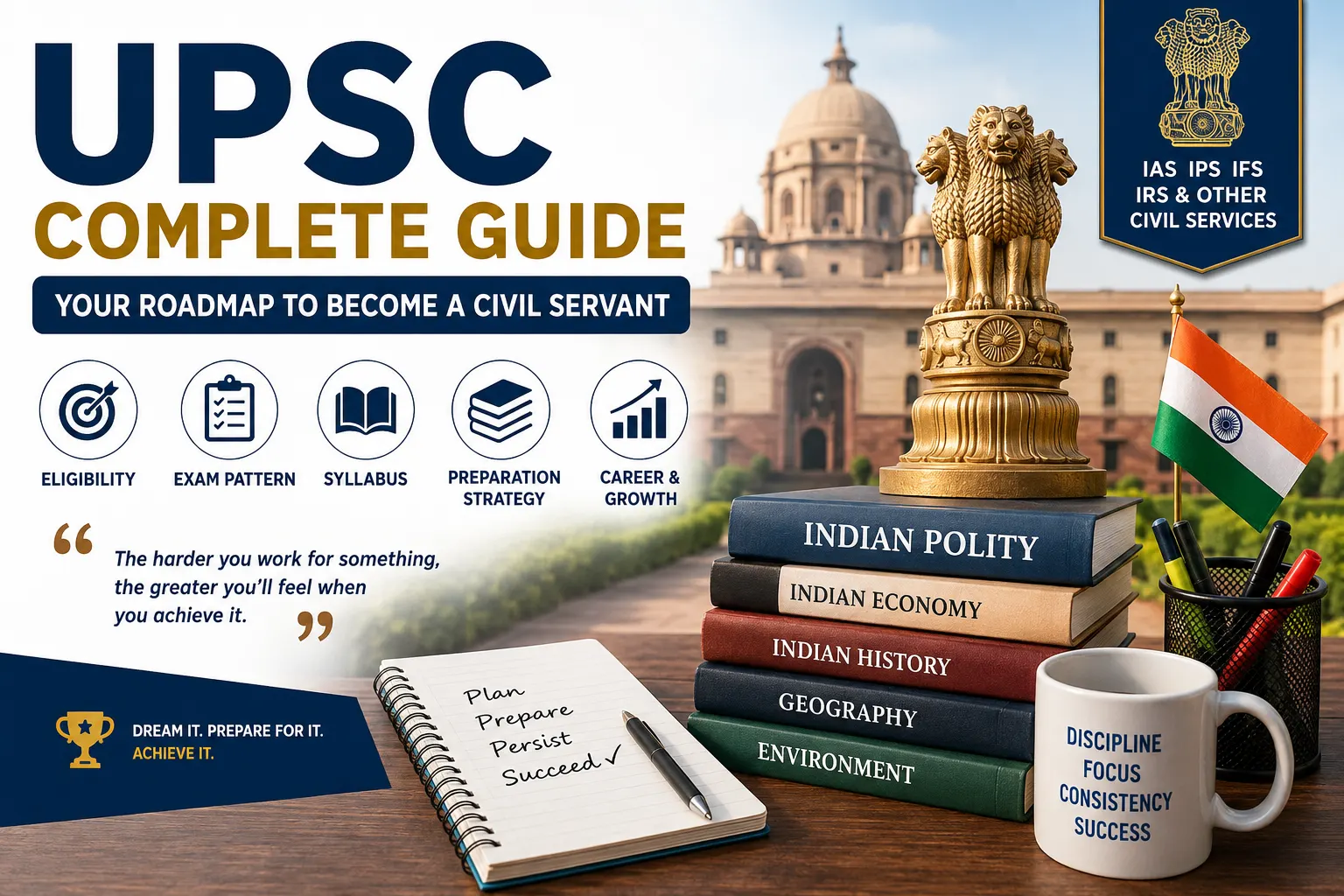
The Union Public Service Commission (UPSC) conducts the prestigious Civil Services Examination (CSE), one of the most competitive examinations in India. Every year, lakhs of aspirants appear for the exam to secure positions such as Indian Administrative Service (IAS), Indian Police Service (IPS), Indian Foreign Service (IFS), and several other Group A and Group B Central Services. This evergreen guide is designed for beginners as well as experienced aspirants. Whether you are planning to start your preparation after Class 12, graduation, or while working, this page provides all the essential information in one place. Instead of searching multiple websites, you can use this guide as your complete UPSC roadmap covering eligibility, age limit, syllabus, exam pattern, preparation strategy, recommended books, career opportunities, salary, and frequently asked questions.
Why This Guide?
This article is regularly updated and covers almost every important aspect of the UPSC Civil Services Examination. You can bookmark this page and revisit it whenever you need information related to UPSC eligibility, syllabus, preparation, or exam updates.
Success in UPSC
"Consistency, discipline, smart revision, and quality study resources matter far more than studying for long hours."
Who Should Read This Guide?
- Students preparing after Class 12
- Graduation students
- Working professionals
- First-time UPSC aspirants
- Candidates preparing for IAS, IPS, IFS and other Civil Services
- Anyone looking for a complete UPSC roadmap in one place
UPSC Civil Services Examination Overview
The UPSC Civil Services Examination (CSE) is India's premier recruitment examination conducted annually by the Union Public Service Commission. It serves as the gateway to some of the country's most prestigious administrative, police, foreign, and revenue services. The examination is conducted in three stages—Preliminary Examination, Main Examination, and Personality Test (Interview). Candidates who successfully clear all stages are allocated services based on their rank, category, preferences, and the number of vacancies available. The examination is known for its vast syllabus, analytical approach, and emphasis on conceptual understanding, current affairs, ethics, decision-making, and administrative aptitude.
UPSC Civil Services Examination Overview
The Union Public Service Commission (UPSC) conducts the Civil Services Examination (CSE), one of India's most prestigious and competitive examinations. Every year, lakhs of candidates apply with the dream of joining the country's top administrative services such as the Indian Administrative Service (IAS), Indian Police Service (IPS), Indian Foreign Service (IFS), and several other Central Civil Services. The examination evaluates a candidate's knowledge, analytical ability, decision-making skills, communication, ethics, and overall personality. Successful candidates are appointed to leadership roles where they contribute to policy implementation, governance, law enforcement, diplomacy, revenue administration, and public welfare.
| Particular | Details |
|---|---|
| Exam Name | UPSC Civil Services Examination (CSE) |
| Conducting Body | Union Public Service Commission (UPSC) |
| Exam Level | National |
| Mode of Examination | Offline (Pen & Paper) |
| Frequency | Once Every Year |
| Selection Stages | Preliminary Exam, Main Examination, Personality Test |
| Official Language | English & Hindi (along with other approved languages where applicable) |
| Job Location | Across India and Indian Missions Abroad (for certain services) |
| Official Website | https://upsc.gov.in |
What is UPSC?
The Union Public Service Commission (UPSC) is India's constitutional recruiting agency responsible for conducting examinations for various prestigious Central Government services. Established under Articles 315 to 323 of the Constitution of India, UPSC ensures a transparent and merit-based recruitment process.
Apart from the Civil Services Examination, UPSC also conducts examinations such as Engineering Services Examination (ESE), Combined Defence Services (CDS), National Defence Academy (NDA), Combined Medical Services (CMS), Indian Forest Service (IFoS), Central Armed Police Forces (CAPF), and several recruitment tests for various government departments.
Why is UPSC Considered India's Toughest Examination?
- Extremely vast syllabus.
- Highly competitive selection process.
- Very limited vacancies compared to applicants.
- Focus on analytical and conceptual understanding.
- Current affairs play a major role.
- Multiple examination stages.
- Personality assessment through interview.
Services Offered Through UPSC Civil Services Examination
Candidates selected through UPSC CSE are allocated services based on their rank, preferences, category, medical standards, and available vacancies. These services offer excellent career growth, responsibility, and opportunities to contribute to nation-building.
| Service | Role |
|---|---|
| Indian Administrative Service (IAS) | District Administration, Policy Implementation, Governance |
| Indian Police Service (IPS) | Law Enforcement, Internal Security, Police Administration |
| Indian Foreign Service (IFS) | Diplomacy, Foreign Affairs, International Relations |
| Indian Revenue Service (IRS) | Income Tax and Customs Administration |
| Indian Audit and Accounts Service (IA&AS) | Government Audit and Financial Accountability |
| Indian Defence Accounts Service (IDAS) | Financial Management of Defence Services |
| Indian Information Service (IIS) | Government Media and Public Communication |
| Indian Postal Service (IPoS) | Postal Administration and Logistics |
| Railway Protection Force & Other Group A Services | Administrative and Executive Responsibilities |
Career Advantages
- High social respect and responsibility.
- Competitive salary and government benefits.
- Opportunities to work across India.
- Leadership roles in administration.
- Promotion to senior policymaking positions.
- Job security and pension benefits (as applicable).
UPSC Civil Services Eligibility Criteria
Before applying for the Civil Services Examination, candidates must ensure that they satisfy the eligibility conditions prescribed in the official UPSC notification. The eligibility criteria primarily include nationality, educational qualification, age limit, and the number of permissible attempts.
Basic Eligibility Overview
- Candidate must satisfy the prescribed nationality requirements.
- A recognized bachelor's degree is generally required.
- Minimum age requirement must be fulfilled.
- Candidate should not exceed the maximum permissible attempts applicable to their category.
- Applicants must meet all conditions mentioned in the official notification.
The detailed information regarding age limit, educational qualification, nationality requirements, reservation benefits, and attempt limits is explained in the following sections.
UPSC Age Limit & Attempt Limits
The age limit for the UPSC Civil Services Examination is determined as per the official notification issued each year. The minimum age requirement is based on the prescribed cut-off date, while the maximum age varies according to the candidate's category. Certain reserved categories are eligible for age relaxation as per Government of India rules.
| Category | Minimum Age | Maximum Age | Maximum Attempts |
|---|---|---|---|
| General (UR) | 21 Years | 32 Years | 6 |
| OBC | 21 Years | 35 Years | 9 |
| SC / ST | 21 Years | 37 Years | Unlimited (up to age limit) |
| EWS | 21 Years | 32 Years | 6 |
| PwBD | 21 Years | Category-wise relaxation as per UPSC rules | As per official notification |
Important Note
The exact age calculation date, relaxation rules, and permissible attempts may vary according to the official UPSC notification. Candidates should always verify the latest notification before submitting the application form.
Nationality Criteria
Nationality requirements differ depending on the service allocated through the Civil Services Examination. Some services require Indian citizenship, while others allow certain additional categories specified by the Government of India.
- Indian citizens are eligible for all Civil Services, including IAS, IPS, and IFS.
- Other nationality categories may be eligible for selected services as specified in the official notification.
- Candidates must produce valid supporting documents whenever required.
Document Verification
All nationality-related documents are verified during different stages of the recruitment process. Providing incorrect information may result in cancellation of candidature.
Educational Qualification
Candidates must possess a bachelor's degree from a recognized university or an equivalent qualification recognized by the Government of India. Final-year students who fulfill the conditions mentioned in the notification may also be eligible to apply, subject to producing proof of qualification within the prescribed timeline.
| Qualification | Eligibility |
|---|---|
| Bachelor's Degree | Eligible |
| Final Year Graduation | Eligible (subject to notification conditions) |
| Professional Degrees | Eligible if recognized |
| Distance Education | Eligible if awarded by a recognized institution |
Can Students from Any Stream Apply?
Yes. Candidates from Science, Commerce, Arts, Engineering, Medical, Agriculture, Law, Management, and other recognized disciplines can apply for the UPSC Civil Services Examination, provided they satisfy the eligibility conditions.
Quick Eligibility Tips
- Read the latest UPSC notification carefully before applying.
- Keep your educational certificates and identity documents ready.
- Check your age eligibility based on the official cut-off date.
- Count previous attempts accurately before filling the application form.
- Use only correct personal and academic information while registering.
- Keep scanned documents prepared in the required format and size.
- Regularly visit the official UPSC website for the latest announcements.
UPSC Civil Services Selection Process
The UPSC Civil Services Examination follows a three-stage selection process designed to evaluate a candidate's knowledge, analytical ability, decision-making skills, personality, and overall suitability for public administration. Candidates must qualify each stage to progress to the next.
The three stages are:
- Preliminary Examination (Prelims)
- Main Examination (Mains)
- Personality Test (Interview)
| Stage | Purpose | Result |
|---|---|---|
| Preliminary Examination | Screening Test | Qualifying for Mains |
| Main Examination | Written Examination | Marks Count for Final Merit |
| Personality Test | Interview | Marks Count for Final Merit |
Important Information
Marks obtained in the Preliminary Examination are not added to the final merit list. Only the marks obtained in the Main Examination and Personality Test determine the final ranking of candidates.
UPSC Preliminary Examination
The Preliminary Examination is the first stage of the UPSC Civil Services Examination. It is conducted in offline mode and consists of objective-type multiple-choice questions (MCQs). The primary purpose of this stage is to shortlist candidates for the Main Examination.
The Preliminary Examination includes two papers:
- General Studies Paper I
- General Studies Paper II (CSAT)
Purpose of Prelims
The Preliminary Examination acts as a screening stage. Candidates who score above the prescribed cut-off in General Studies Paper I and qualify the CSAT paper become eligible to appear for the Main Examination.
UPSC Prelims Exam Pattern
| Paper | Subject | Questions | Maximum Marks | Duration |
|---|---|---|---|---|
| Paper I | General Studies | 100 | 200 | 2 Hours |
| Paper II | CSAT | 80 | 200 | 2 Hours |
Key Highlights
- Both papers are conducted on the same day.
- Each question is objective type.
- Paper II (CSAT) is qualifying in nature.
- Candidates must qualify CSAT as per UPSC rules.
- Only General Studies Paper I is considered for the Prelims cut-off.
Negative Marking in UPSC Prelims
The Preliminary Examination follows a negative marking system for incorrect answers. Candidates should answer questions carefully to maximize their score and avoid unnecessary penalties.
Negative Marking Rules
- Incorrect answers attract negative marking.
- Unanswered questions do not receive any penalty.
- Guesswork without elimination should generally be avoided.
- Attempt only those questions where you have reasonable confidence.
Smart question selection and effective elimination techniques often improve the overall score more than attempting every question.
Preliminary Examination Qualifying Rules
To qualify for the Main Examination, candidates must satisfy the qualifying requirements prescribed by UPSC. Clearing only one paper is not sufficient.
Remember These Points
- General Studies Paper I determines the Prelims cut-off.
- CSAT is qualifying in nature.
- Candidates must qualify both requirements to be shortlisted.
- The number of candidates selected for Mains depends on vacancies and official UPSC criteria.
- Prelims marks are not included in the final merit list.
UPSC Main Examination
The UPSC Main Examination is the second stage of the Civil Services Examination and plays a decisive role in the final merit list. Unlike the Preliminary Examination, the Mains consists of descriptive papers that evaluate a candidate's analytical thinking, writing ability, conceptual understanding, ethics, and depth of knowledge.
Candidates who qualify the Preliminary Examination are eligible to appear for the Main Examination. Performance in the Mains significantly influences the final ranking because these marks are counted in the final merit.
| Paper | Subject | Marks |
|---|---|---|
| Paper A | Indian Language (Qualifying) | 300 |
| Paper B | English (Qualifying) | 300 |
| Paper I | Essay | 250 |
| Paper II | General Studies I | 250 |
| Paper III | General Studies II | 250 |
| Paper IV | General Studies III | 250 |
| Paper V | General Studies IV (Ethics) | 250 |
| Paper VI | Optional Subject Paper I | 250 |
| Paper VII | Optional Subject Paper II | 250 |
Important Note
The marks obtained in the seven merit papers of the Main Examination are added to the Personality Test marks to prepare the final merit list. The qualifying language papers are not counted in the final merit.
UPSC Personality Test (Interview)
Candidates who qualify the Main Examination are invited for the Personality Test, commonly known as the UPSC Interview. This stage assesses the candidate's personality, communication skills, leadership qualities, decision-making ability, integrity, confidence, and awareness of national and international issues.
Interview Focus Areas
- Personality and confidence
- Communication skills
- Analytical ability
- Leadership qualities
- Ethical judgment
- General awareness
- Balanced decision-making
How is the Final Merit List Prepared?
The final merit list is prepared by combining the marks obtained in the merit papers of the Main Examination and the Personality Test. Candidates are allotted services based on their rank, category, preferences, medical fitness, and available vacancies.
Final Merit Formula
Final Merit = Mains Marks + Personality Test Marks
The Preliminary Examination is only a screening test, and its marks are not included in the final ranking.
Complete UPSC Exam Pattern at a Glance
| Stage | Mode | Question Type | Marks Counted for Final Merit |
|---|---|---|---|
| Preliminary Examination | Offline | Objective (MCQ) | No |
| Main Examination | Offline | Descriptive | Yes |
| Personality Test | Face-to-Face | Interview | Yes |
Important Points Every UPSC Aspirant Should Remember
- Understand the syllabus thoroughly before starting preparation.
- Read standard books instead of relying on too many resources.
- Build a strong habit of reading newspapers and current affairs daily.
- Practice answer writing regularly for the Main Examination.
- Solve previous years' question papers to understand the exam pattern.
- Take mock tests to improve time management and accuracy.
- Revise consistently to strengthen concepts and retention.
- Focus on conceptual clarity rather than rote learning.
- Maintain consistency, discipline, and a realistic study plan.
UPSC Preliminary Examination Syllabus
The UPSC Preliminary Examination is the first stage of the Civil Services Examination. It consists of two objective-type papers: General Studies Paper I and General Studies Paper II (CSAT). While General Studies Paper I determines the cut-off for qualification, CSAT is qualifying in nature and tests aptitude, reasoning, and comprehension skills.
Prelims Syllabus Overview
- Two objective-type papers.
- General Studies Paper I is used for preparing the merit list for Prelims qualification.
- CSAT is qualifying in nature.
- Questions are designed to test conceptual understanding, analytical ability, and current affairs awareness.
General Studies Paper I Syllabus
General Studies Paper I covers a wide range of subjects that assess a candidate's understanding of national and international issues, history, geography, polity, economy, environment, science, and current affairs.
| Subject | Major Topics |
|---|---|
| Current Events | National and International Current Affairs, Government Initiatives, Important Reports, International Organizations |
| History | Ancient, Medieval, Modern Indian History, Indian National Movement, Freedom Struggle |
| Geography | Physical Geography, Indian Geography, World Geography, Climate, Resources, Agriculture, Mapping |
| Indian Polity | Constitution, Fundamental Rights, Parliament, Judiciary, Executive, Local Government, Constitutional Bodies |
| Economy | Basic Economics, Inflation, Banking, Budget, Taxation, Economic Development, Government Schemes |
| Environment | Biodiversity, Ecology, Climate Change, Conservation, Environmental Organizations |
| General Science | Physics, Chemistry, Biology, Biotechnology, Space, Health, Technology |
Important Preparation Advice
Focus on building conceptual clarity instead of memorizing facts. Integrate static subjects with current affairs to improve problem-solving ability in the Preliminary Examination.
General Studies Paper II (CSAT) Syllabus
The Civil Services Aptitude Test (CSAT) evaluates a candidate's aptitude, reasoning ability, decision-making skills, comprehension, and basic quantitative aptitude. Although it is qualifying in nature, adequate preparation is essential.
| Area | Topics Covered |
|---|---|
| Reading Comprehension | Passage-Based Questions, Interpretation, Inference |
| Logical Reasoning | Analytical Reasoning, Statements, Conclusions, Arguments |
| Decision Making | Situational Judgement, Problem Solving |
| Basic Numeracy | Percentage, Ratio, Profit & Loss, Average, Time & Work, Time & Distance |
| Data Interpretation | Charts, Tables, Graphs, Caselets |
| Mental Ability | Logical Thinking and Analytical Skills |
CSAT Preparation Tips
- Practice comprehension passages regularly.
- Strengthen logical reasoning through daily exercises.
- Revise basic mathematics concepts.
- Solve previous years' CSAT papers.
- Attempt full-length mock tests to improve speed and accuracy.
High-Weightage Topics for UPSC Prelims
While the UPSC syllabus is broad, certain topics consistently receive significant attention in the Preliminary Examination. Candidates should prioritize these areas during revision.
| Subject | Priority Level |
|---|---|
| Current Affairs | Very High |
| Indian Polity | Very High |
| Environment & Ecology | Very High |
| Economy | High |
| Modern History | High |
| Geography | High |
| Science & Technology | Moderate to High |
Preparation Strategy for Prelims
- Complete the static syllabus before intensive current affairs revision.
- Solve previous years' question papers to understand trends.
- Take sectional and full-length mock tests regularly.
- Maintain concise revision notes for quick revision.
- Avoid using too many study resources; focus on quality over quantity.
UPSC Main Examination Syllabus
The UPSC Main Examination is designed to evaluate a candidate's intellectual depth, analytical thinking, writing ability, decision-making skills, and overall understanding of governance, society, economy, ethics, and international affairs. Unlike the Preliminary Examination, the Mains consists of descriptive papers that require structured and well-articulated answers.
UPSC Mains at a Glance
- Descriptive (written) examination.
- Seven merit papers contribute to the final ranking.
- Essay writing is an important scoring component.
- General Studies papers cover diverse interdisciplinary subjects.
- Answer writing practice is essential for success.
Essay Paper
The Essay paper evaluates a candidate's ability to organize ideas logically, present balanced arguments, and communicate effectively. Candidates are expected to write well-structured essays on topics related to governance, society, economy, ethics, science, technology, philosophy, education, environment, and current affairs.
Essay Preparation Tips
- Develop a habit of writing essays regularly.
- Use facts, examples, and balanced viewpoints.
- Maintain logical flow and coherent structure.
- Conclude with practical and optimistic solutions.
General Studies Paper I
General Studies Paper I focuses on Indian Heritage and Culture, History, Geography, and Society. It assesses a candidate's understanding of India's historical evolution, cultural diversity, geographical features, and social challenges.
| Area | Important Topics |
|---|---|
| Indian Heritage & Culture | Art, Architecture, Literature, Cultural Institutions |
| Modern Indian History | Freedom Struggle, Reform Movements, Post-Independence Developments |
| World History | Industrial Revolution, World Wars, Colonization, Global Events |
| Indian Society | Diversity, Women, Population, Poverty, Urbanization |
| Geography | Physical Geography, Resources, Climate, Disaster Management |
General Studies Paper II
This paper primarily covers the Indian Constitution, governance, social justice, polity, international relations, and government policies.
| Area | Topics |
|---|---|
| Indian Constitution | Constitutional Framework, Amendments, Fundamental Rights |
| Governance | Government Policies, Transparency, Accountability, E-Governance |
| Parliament & Judiciary | Legislative Process, Judicial System, Constitutional Bodies |
| Social Justice | Education, Health, Welfare Schemes, Inclusive Development |
| International Relations | India's Foreign Policy, Bilateral Relations, Global Organizations |
General Studies Paper III
General Studies Paper III focuses on economic development, agriculture, science and technology, environment, internal security, and disaster management.
| Area | Topics |
|---|---|
| Indian Economy | Growth, Budget, Banking, Inflation, Inclusive Development |
| Agriculture | Food Security, Irrigation, Agricultural Reforms |
| Science & Technology | Innovation, Biotechnology, Space, Artificial Intelligence |
| Environment | Climate Change, Biodiversity, Conservation |
| Disaster Management | Preparedness, Risk Reduction, Disaster Response |
| Internal Security | Cyber Security, Border Management, Terrorism |
General Studies Paper IV (Ethics, Integrity & Aptitude)
This paper evaluates ethical values, integrity, aptitude, emotional intelligence, public service values, and case study-based decision-making skills.
Major Topics
- Ethics and Human Values
- Integrity and Probity in Public Life
- Emotional Intelligence
- Public Administration Ethics
- Attitude and Aptitude
- Case Studies
- Accountability and Transparency
- Ethical Decision Making
Preparation Advice
"Success in the UPSC Mains depends not only on knowledge but also on the ability to present clear, structured, and balanced answers within the prescribed time."
UPSC Optional Subject
The Optional Subject is one of the most important components of the UPSC Main Examination. Candidates must select one optional subject from the list prescribed by UPSC. The chosen subject consists of two papers, and both papers carry significant weight in the final merit list. Selecting the right optional subject depends on your academic background, personal interest, availability of study material, previous knowledge, and answer-writing ability. There is no universally "best" optional subject because success depends on the candidate's preparation strategy.
Factors to Consider While Choosing an Optional Subject
- Personal interest in the subject.
- Availability of quality study material.
- Previous academic background.
- Availability of guidance and test series.
- Overlap with General Studies syllabus.
- Previous years' question trends.
- Your ability to write analytical answers.
Popular Optional Subjects
| Optional Subject | Suitable For | GS Overlap |
|---|---|---|
| Public Administration | Most Aspirants | High |
| Political Science & International Relations | Humanities Students | Very High |
| Geography | Science & Arts Students | High |
| History | History Enthusiasts | High |
| Sociology | Beginners | Moderate |
| Anthropology | Science Background | Moderate |
| Economics | Commerce & Economics Students | High |
| Mathematics | Engineering & Mathematics Students | Low |
| Physics | Science Students | Low |
| Chemistry | Science Students | Low |
Best Books for UPSC Preparation
Using limited but reliable resources is one of the keys to successful UPSC preparation. Instead of referring to multiple books for the same topic, candidates should revise standard resources multiple times.
| Subject | Recommended Resource |
|---|---|
| Indian Polity | M. Laxmikanth |
| Modern History | A Brief History of Modern India |
| Ancient & Medieval History | NCERT Books |
| Geography | NCERT + Atlas |
| Economy | Basic Economy Reference Book + Current Affairs |
| Environment | Standard Environment Reference Book |
| Ethics | Ethics Reference Book + Case Studies Practice |
| Current Affairs | Daily Newspaper & Monthly Revision Notes |
Remember
Do not keep changing study materials. Revision is more important than collecting new books. Master a few trusted resources and revise them consistently.
How to Complete the UPSC Syllabus Efficiently
The UPSC syllabus is extensive, but it becomes manageable when divided into small, achievable goals. A disciplined study plan combined with consistent revision and regular mock tests significantly improves preparation quality.
Effective Syllabus Completion Strategy
- Start with NCERT textbooks to build strong fundamentals.
- Complete one subject at a time instead of studying everything simultaneously.
- Prepare concise revision notes for every subject.
- Revise every week to improve long-term retention.
- Solve Previous Year Question Papers (PYQs) after completing each subject.
- Attempt sectional and full-length mock tests regularly.
- Improve answer-writing skills for the Main Examination.
- Read newspapers daily and connect current affairs with the static syllabus.
- Track your progress through a monthly revision schedule.
- Focus on consistency rather than studying for excessively long hours.
Final Advice
"UPSC is not a test of how much you can study in a day; it is a test of how consistently you can study for months with discipline, revision, and continuous self-improvement."
UPSC Salary, Pay Scale & Benefits
One of the biggest advantages of joining the Civil Services is the opportunity to serve the nation while enjoying a competitive salary, excellent career growth, and various government benefits. Officers selected through the UPSC Civil Services Examination receive salaries based on the recommendations of the latest Central Pay Commission along with several allowances.
| Service | Approximate Entry Pay Level | Career Scope |
|---|---|---|
| Indian Administrative Service (IAS) | Level 10 | District Administration, Policy Making, Governance |
| Indian Police Service (IPS) | Level 10 | Law Enforcement & Internal Security |
| Indian Foreign Service (IFS) | Level 10 | Diplomatic & International Assignments |
| Indian Revenue Service (IRS) | Level 10 | Tax Administration & Investigation |
| Other Group A Services | Level 10 | Central Government Administration |
Major Benefits
- Dearness Allowance (DA).
- House Rent Allowance (where applicable).
- Travel Allowance.
- Medical facilities.
- Government accommodation (subject to availability).
- Official vehicle and staff for eligible posts.
- Pension and retirement benefits as per applicable rules.
- Training and professional development opportunities.
Career Growth & Promotion
Civil Services provide structured career progression with opportunities to work at district, state, national, and international levels. Promotions are based on service rules, experience, performance, seniority, and departmental requirements.
| Service | Typical Career Progression |
|---|---|
| IAS | Sub-Divisional Magistrate → District Magistrate → Divisional Commissioner → Principal Secretary → Chief Secretary → Cabinet Secretary |
| IPS | Assistant Superintendent of Police → Superintendent of Police → Deputy Inspector General → Inspector General → Director General of Police |
| IFS | Under Secretary → First Secretary → Counsellor → Ambassador / High Commissioner |
Why Choose Civil Services?
- Leadership opportunities.
- National-level impact.
- Administrative authority.
- Continuous learning and training.
- Job stability and professional respect.
- Opportunity to contribute to public welfare.
UPSC Preparation Strategy for Beginners
A successful UPSC preparation strategy focuses on conceptual clarity, disciplined study, regular revision, and continuous practice. Candidates should avoid collecting excessive study material and instead master a limited number of reliable resources.
Step-by-Step Preparation Plan
- Understand the complete UPSC syllabus before starting preparation.
- Analyze previous years' question papers.
- Build a strong foundation with NCERT textbooks.
- Study one standard reference book for each subject.
- Read newspapers and current affairs daily.
- Prepare concise revision notes.
- Practice answer writing for the Main Examination.
- Solve mock tests regularly.
- Revise multiple times before the examination.
- Maintain consistency throughout the preparation journey.
Common Mistakes to Avoid
- Ignoring the official syllabus.
- Using too many study resources.
- Skipping revision.
- Not practicing answer writing.
- Avoiding mock tests.
- Neglecting current affairs.
- Studying without a proper timetable.
Previous Year Cut-Off Trends
The UPSC cut-off varies every year depending on several factors, including the number of vacancies, difficulty level of the examination, and overall candidate performance. Therefore, candidates should use previous cut-off trends only as a reference and not as a fixed target.
| Stage | Cut-Off Trend |
|---|---|
| Preliminary Examination | Varies each year based on exam difficulty and vacancies. |
| Main Examination | Determined after evaluation of descriptive answer sheets. |
| Final Merit | Prepared using Mains marks and Personality Test marks. |
Important Advice
Do not prepare only to clear the previous year's cut-off. Aim to build a strong conceptual foundation and maximize your score through consistent practice, revision, and mock tests.
Frequently Asked Questions (FAQs)
1. What is the UPSC Civil Services Examination?
The UPSC Civil Services Examination (CSE) is India's premier competitive examination conducted for recruitment to IAS, IPS, IFS, IRS and various other Group A and Group B services.
2. Who conducts the UPSC CSE?
The examination is conducted annually by the Union Public Service Commission (UPSC).
3. What is the minimum educational qualification?
Candidates must possess a bachelor's degree from a recognized university or an equivalent qualification.
4. Can final-year students apply?
Yes, subject to the eligibility conditions mentioned in the official notification.
5. Is the UPSC exam conducted every year?
Yes, the Civil Services Examination is normally conducted once every year.
6. How many stages are there in UPSC CSE?
There are three stages: Preliminary Examination, Main Examination, and Personality Test (Interview).
7. Are Prelims marks included in the final merit list?
No. The Preliminary Examination is only a screening test.
8. Which services are offered through UPSC CSE?
Major services include IAS, IPS, IFS, IRS and several other Central Civil Services.
9. Is coaching mandatory for UPSC preparation?
No. Many candidates qualify through disciplined self-study using reliable resources.
10. What is the best strategy to crack UPSC?
Understand the syllabus, study standard books, revise regularly, solve PYQs, attempt mock tests, and practice answer writing consistently.
Conclusion
The UPSC Civil Services Examination is more than just a competitive exam—it's an opportunity to serve the nation through leadership, public administration, and policymaking. Success requires patience, discipline, consistency, and a well-planned preparation strategy.
Start with a clear understanding of the syllabus, build strong fundamentals using standard resources, stay updated with current affairs, and practice regularly through mock tests and previous year question papers. Consistent revision and answer-writing practice are equally important for achieving a good rank.
Keep this guide bookmarked as your evergreen UPSC resource. As the examination evolves, regularly check the latest official notification for updates regarding eligibility, exam dates, vacancies, and other important announcements.
Best Wishes!
"Success in UPSC is the result of consistent effort, continuous learning, disciplined revision, and unwavering determination."